My last day at my old job was a Thursday in late September. The next morning I woke up at the usual time, made coffee, and sat down at my desk out of pure habit, and then realized there was nothing on my calendar. No standup, no stakeholder meeting, no dashboard someone needed by Friday. Just a blank week, and then another one behind it.
I've been on the other side of layoffs before, watching colleagues go. This is the first time it's been me. And the thing nobody really tells you is that the hardest part of the first few weeks isn't the money or even the job search. It's the shape of the day disappearing.
The first two weeks
For the first two weeks, I didn't have a plan, and they were rough. I hadn't realized how much quiet work a job does for your head until it was gone. It tells you when to get up. It gives you people to talk to. It hands you small problems to solve and small wins when you solve them. It gives every week a beginning and an end.
Without it, the days started to blur. I slept a little later. I checked job boards at eleven at night. I refreshed my inbox the way I used to refresh the USCIS status page, as if checking more often would make the answer come sooner. None of it felt like a crisis. It just slowly turned the volume down on everything.
I got curious whether this was just me, so I went looking. I found a Gallup survey from 2013 that asked over 350,000 Americans about depression. About 6 in every 100 full-time workers said they had it or were being treated for it. Among unemployed people, it was about 12 in 100. Among people who'd been out of work for six months or longer, it was 18. Then I checked how many people are in that last group today, expecting it to be small. It isn't. The September 2026 jobs report says about 1.9 million people in the US had been looking for work for more than half a year, a little over a quarter of everyone unemployed.
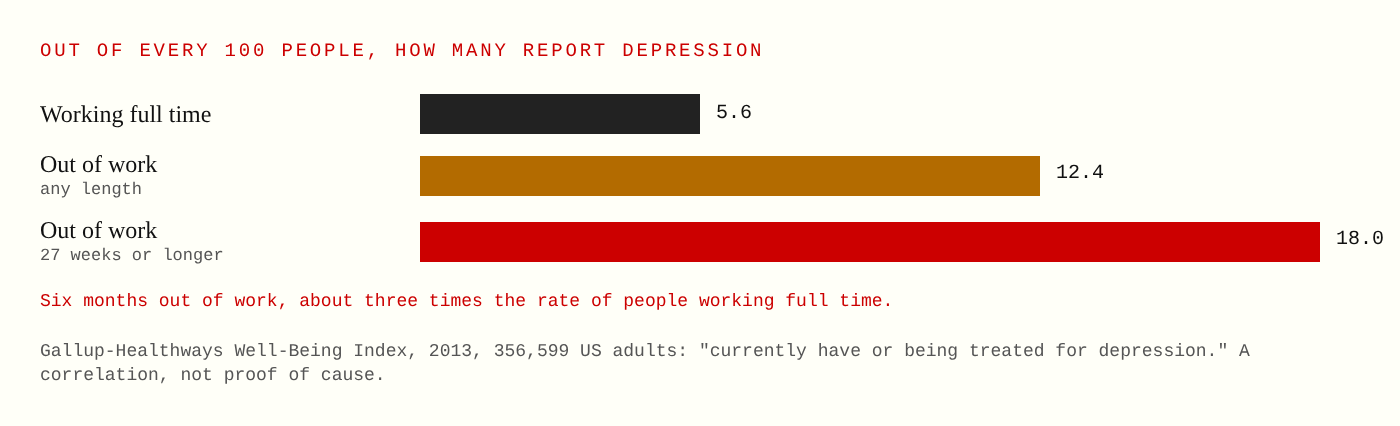
Share of US adults who said they currently have or are being treated for depression, 2013. Source: Gallup-Healthways Well-Being Index. It's a correlation, not proof that losing a job causes depression, but the direction is hard to ignore.
I'm not sharing that to scare anyone. Reading it is what made me stop drifting. The longer this goes, the harder it gets to hold yourself together, and I didn't want to find out how hard.
The routine
So I built a system, and I've mostly stuck to it. It's boring on purpose.
I wake up at 7. I meditate, stretch, and make coffee before I touch a screen. Then I spend two hours applying for and researching jobs. After that I walk the dogs, which is the best part of the morning and also a hard stop on the job search. Then I put three or four hours into palStack, our startup. Then two hours of learning. At 5, the laptop closes, and the evening is for reading and the rest of life.
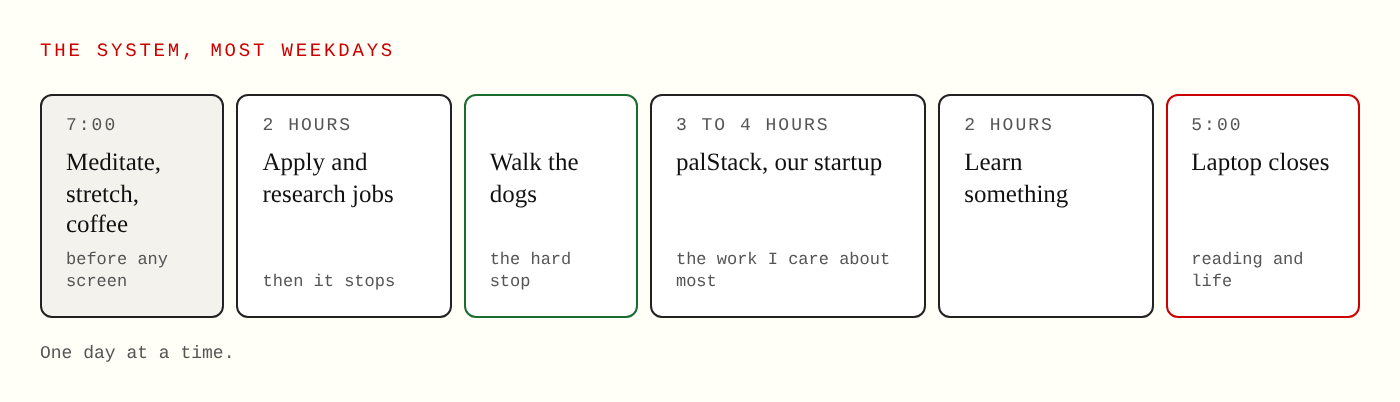
The system, most weekdays. The dog walk in the middle is doing more work than it looks like.
The routine isn't about being productive. Some days I get a lot done and some days I don't. I'm taking it one day at a time. It's about the day having edges. When the day has a start and an end, a slow day is just a slow day. When it doesn't, a slow day starts to feel like proof of something.
The other thing I learned quickly is to keep the job search inside a box. If it's allowed to fill every hour, it will, and most of those hours go to refreshing and worrying instead of applying. So it gets its own time, it gets done properly, and then I close it and do something else. I'll write separately about how I've organized that part, because I ended up building some tools for it.
A few weeks I didn't plan to have
Here's the part I really want to say.
I am grateful that I can treat this as a short sabbatical. Not everyone can, and I want to be honest about why I can. There are three main reasons. I have a green card, so there's no visa clock counting down on me the way there would have been a few years ago. We have savings that give us room to breathe. And my wife's paycheck keeps the household steady while mine is paused. Those three things are why I can approach this lightly instead of in a panic. That combination is a privilege, and I don't want to write this post pretending it isn't.
What it means in practice is that I get to choose what these weeks are for. And I've chosen to use some of them on things I never had enough time for while working full time.
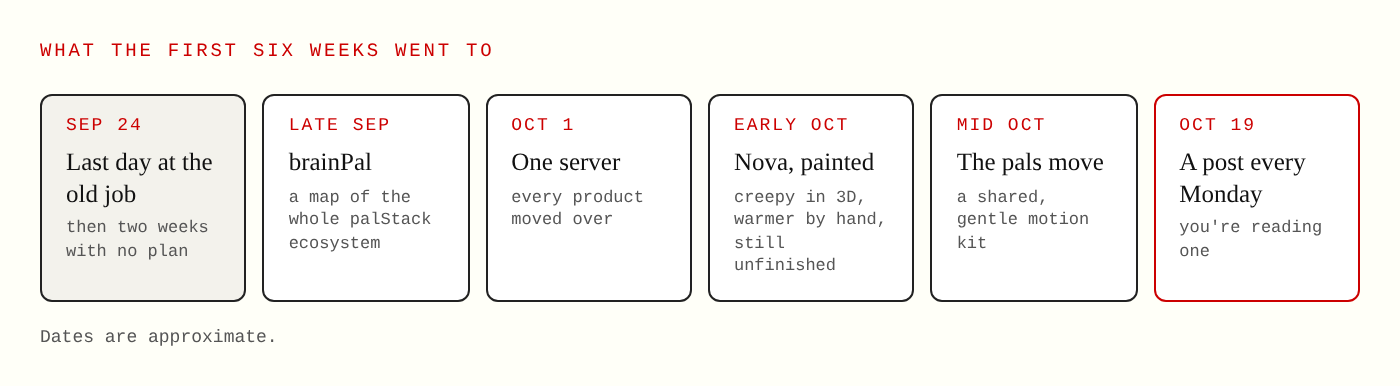
What the first six weeks actually went to. Most of it is palStack work I'd been putting off for months.
Most of it went into palStack. Nova, finPal's dog, went from a creepy 3D model to something painted and much warmer, and she's still not finished. We moved every product onto one server and built brainPal so our AI agents can learn the whole ecosystem before touching it. The apps learned to move, gently. And this blog went from "whenever I get to it" to one post every Monday, which you're reading the result of.
None of that pays the bills right now. But it's the work I care about most, and getting to give it my full attention for a few weeks has been genuinely good for me. It reminds me that I'm still someone who builds things, even when nobody's paying me to.
If you're in the first few weeks
If you've just been laid off, I'm not going to tell you to treat it as a gift. It isn't one, and the parts that are hard are hard. But I'd gently suggest two things. Give the days a shape sooner than I did. Two weeks of drifting was enough to show me how fast it sets in. And if you have even a little room, spend some of it on something that's yours. A project, a skill, a long walk, anything that reminds you who you are outside a job title.
I don't know yet what comes next for me. I'm looking, and I'll find the right thing. In the meantime, I'm up at 7, the dogs get their walk, the laptop closes at 5, and I take it one day at a time.